
Riding the Bandwagon Without Getting Thrown Off: A Small Business Owner's Guide to Trend-Chasing
By Peter Smith, Co-Founder of BASE — Business Assistance for Small Enterprises
Bubble tea. Anime merch. Cold plunge studios. Matcha everything. Every year there's a new wave, and every year a batch of new business owners rush to catch it. Some of them build lasting businesses. Many never make it past the first couple of years.
The difference is rarely the trend itself. It's whether they understood what they were actually selling—and whether they recognized where the market was in its cycle before jumping in.

Anime Isn't New — I Promise You
My nephews, my niece, and their friends act like anime is a newish thing. To them, it showed up sometime in the last few years and never left. I get it — from where they're standing, that's true.
But I grew up in Boston, and anime has been part of my life for as long as I can remember—long before it had its own aisle at major retailers or became part of mainstream pop culture. I grew up watching classics like Star Blazers, Robotech, Force Five, Grandizer, Gaiking, and Battle of the Planets (or G-Force, if you know, you know). And a lot of people don't realize how many of the "American" cartoons they grew up on — Transformers included — were actually produced or animated by Japanese studios. It was anime the whole time; it just wasn't marketed as anime.
Back then, if you wanted your anime fix, you didn't scroll an app. You went to Harvard Square, found the one shop that imported it, and hoped they had something new in stock. Today it's everywhere—streaming services, major retailers, conventions, and malls across the country.
That's the lesson. Anime didn't suddenly become popular. The market had been growing for decades before most people noticed it. Many entrepreneurs mistake visibility for the beginning of a trend, when in reality they're seeing the middle—or even the later stages—of its growth.
And you can see the saturation in real time now. Walk into many mall-based anime stores today and you'll notice something interesting. The merchandise often looks remarkably similar—many of the same figures, shirts, plushes, and licensed products arranged in nearly identical layouts. That's what saturation looks like. Businesses stop competing through differentiation and start competing by selling the same inventory.
To be fair, anime isn't going anywhere. Industry forecasts continue to project growth through the early 2030s. The bigger question isn't whether people love anime—it's how they buy it.
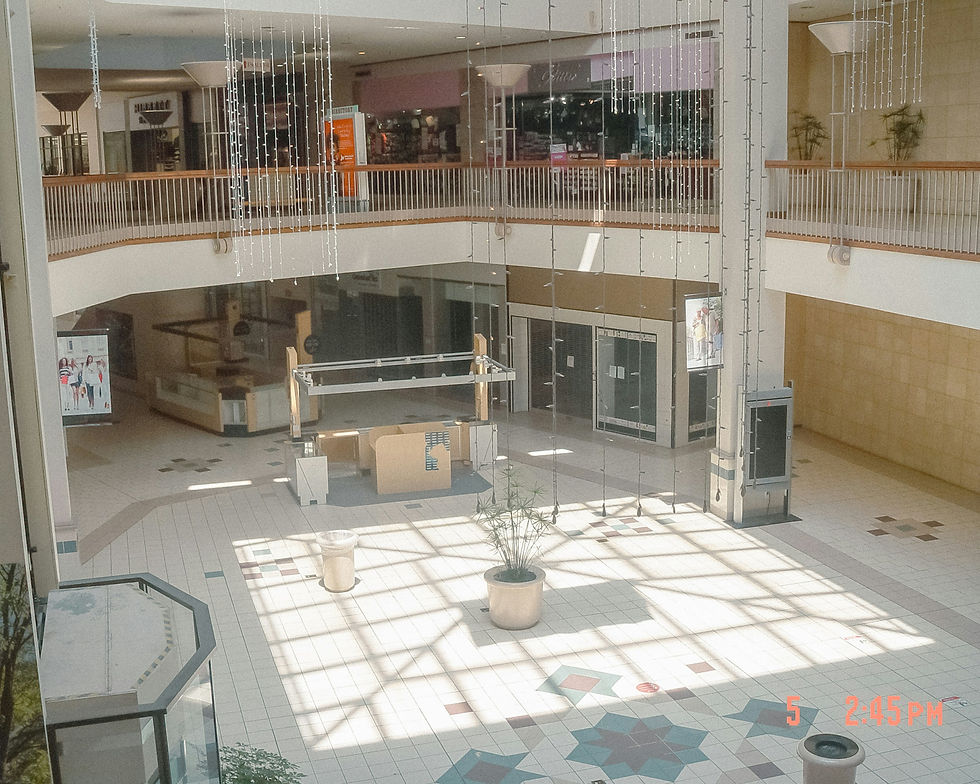
Traditional malls have been losing foot traffic for years. More than 8,100 U.S. stores closed in 2025 alone, and hundreds of malls are expected to close over the next several years. If your entire business model is built around selling the same licensed merchandise as dozens of other stores in a declining retail environment, you're facing a challenge that has little to do with anime itself.
That's the trap. A market can be growing while the business model built around it is quietly becoming obsolete. Successful entrepreneurs don't just ask, "Is this popular?" They ask, "Is this the best way to serve that market today?"

The Problem With Chasing a Fad
When a trend is peaking, it can look like the safest business opportunity in the world. There's a line out the door at the bubble tea shop across town, so you decide to open one too. But by the time a trend is obvious enough for everyone to notice, it's often well into its growth cycle. You're not catching the wave—you may be paddling out just as it's beginning to break.
Boston offers a good example. In 2025 alone, several major bubble tea brands—including HeyTea, Molly Tea, and Nana's Green Tea—opened new locations while established chains like Kung Fu Tea and Gong Cha continued expanding. That's usually a sign you're no longer looking at the beginning of a trend. You're looking at a crowded marketplace. At that stage, success depends less on offering the product and more on offering a better reason for customers to choose you.
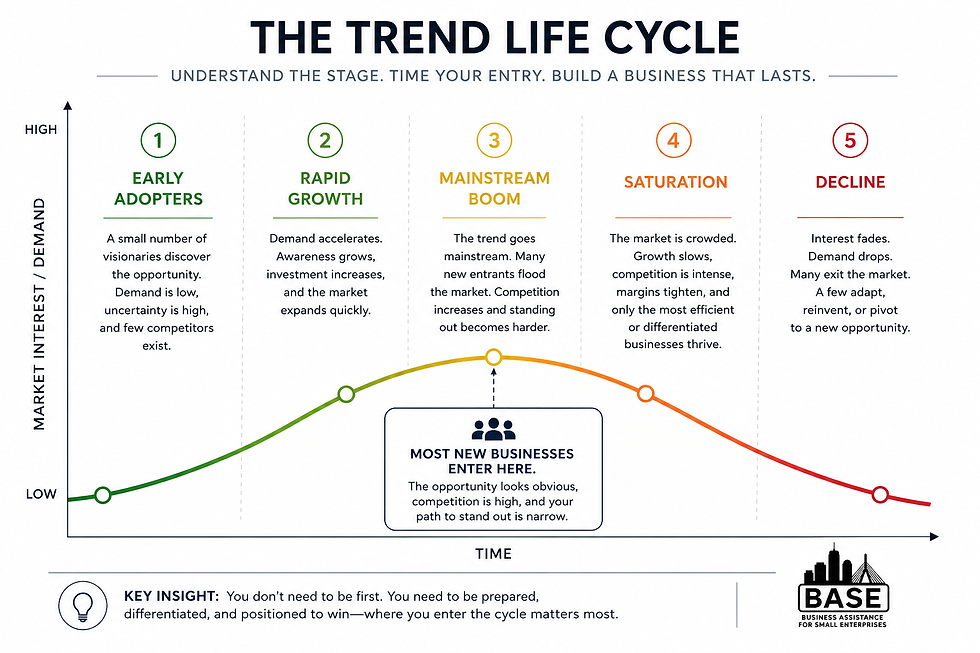
Most trends follow a familiar pattern: early adopters, rapid growth, saturation, and eventually decline. The greatest opportunities are often found before a trend becomes obvious—when demand is growing but competition hasn't yet caught up.
If your business idea starts with, "Everyone's talking about this," it's worth asking a better question: Am I early enough to build something different, or am I arriving just as everyone else has the same idea?
Know What You're Actually Selling
This is the part people skip. Bubble tea isn't the business—it's the product. The actual business is something underneath it: a neighborhood hangout spot, a fast and affordable treat, a customizable drink experience, a photogenic product that markets itself on social media.
The owners who survive the trend's decline are the ones who understood which of those things they were really building. When bubble tea stops being novel, a hangout spot can pivot its menu and keep its regulars. A shop that was purely "bubble tea because bubble tea is popular" has nothing to fall back on.
Same with anime-adjacent retail, fitness fads, or any other wave. Ask yourself: if the trend disappeared tomorrow, what would still be true about why customers come to me? If you don't have an answer, you don't have a business yet — you have a bet.
Build Something You'll Still Enjoy in Five Years
There's a practical reason "you gotta like what you're selling" isn't just a nice sentiment. Trends fade slower than people expect, and the slow fade is brutal. You'll be running this business through the boring middle years, long after the initial excitement wears off — for you and for customers. If you don't actually care about the product, category, or community, you won't have the patience to adjust, improve, and stick around for the unglamorous stretch where the real profit usually shows up.
Owners who like what they sell also tend to spot the real signal faster: they're already in the community, already following the space, already talking to the customers who show up for the fifth time. That's different from someone doing market research on a trend they discovered in a headline.
Invest at the End of the Hype, Not the Peak
Here's the counterintuitive move: some of the best entry points aren't at the top of a trend — they're on the way down, or in a related space nobody's paying attention to yet.
A few ways this plays out:
Equipment and real estate get cheaper as failed bandwagon businesses close and liquidate. A commercial kitchen buildout, walk-in cooler, or retail lease that was competitive and pricey at the peak often becomes available at a discount once the herd thins out.
The customer base matures. Early trend customers wanted novelty. Late-stage customers who are still around want quality and consistency — that's a market you can actually serve well if you're built for staying power, not hype.
Adjacent categories often have room to run even after the core trend saturates. When bubble tea shops were everywhere, boba-adjacent snacks, mochi donuts, and other Asian dessert categories still had space to grow because they hadn't been oversaturated by the copycat wave.
The point isn't "wait until everyone else has failed." It's: don't mistake visibility for opportunity. By the time a trend is obvious enough to notice, ask what's true underneath it that will still matter in three years, and whether you can enter on better terms than the crowd that rushed in first. Markets often overreact on the way up—and overcorrect on the way down. That's where disciplined entrepreneurs find opportunities others miss.
The Short Version
If your only reason for the idea is "this is popular right now," that's a warning sign, not a business plan.
Know what customers are really buying—not just what you're selling.
Only build in a space you genuinely like. You'll need that when the excitement wears off and you're still open.
Sometimes the best opportunity comes after the hype fades.
Build on a Foundation, Not a Fad
Every successful business starts with an idea—but not every idea becomes a successful business. Before investing your savings, signing a lease, or placing your first inventory order, take the time to ask the hard questions. Is there a sustainable market? What problem are you really solving? How will your business stand out when the excitement fades?
At BASE, that's exactly what we help entrepreneurs do. We work with aspiring and established business owners to evaluate ideas, strengthen business models, and build companies designed for long-term success—not just the latest trend.
If you're thinking about starting a business—or wondering whether your current idea has staying power—we'd be happy to help you build on a solid foundation.
Learn more at www.BaseBoston.com.


Comments